Will AI-Rewritten Content Hurt Google Rankings? Judge the Rewrite, Not the Tool
Will AI-rewritten content hurt Google rankings? Not because AI was involved: Google has said since 2023 that it rewards high-quality content however it is produced, and an Ahrefs study of 600,000 pages ranking in Google's top 20 found effectively no correlation between the share of text its detector classed as AI and ranking position. What can cost positions is what a rewrite changes.
Three questions drawn from Google's own documents apply to any rewrite, by hand or with AI: does the page still deliver what its title promises, are its facts right, and is it one of many pages produced mainly to rank rather than to help readers? Each document is cited below with its date.
What 600,000 ranking pages show, and what they cannot
Among pages already ranking in Google's top 20, Ahrefs found no meaningful link between how much of a page its detector classed as AI and where the page ranked. In its own words: "The correlation was 0.011, effectively zero."
| How Ahrefs' detector classed the page | Share of the 600,000 pages |
|---|---|
| Pure AI | 4.6% |
| Pure human | 13.5% |
| A mix of both | 81.9% |
| Containing some AI (mix plus pure AI) | 86.5% |
Ahrefs, 100,000 random keywords, top 20 ranking URLs, published July 7, 2025. Correlation between AI share and position: 0.011.
That 0.011 is a correlation on pages that already rank, not an experiment: it cannot say what would have happened to any one of them. The labels come from Ahrefs' own detector, and Ahrefs states that limit itself: "No AI content detector is perfect. Like LLMs, AI detectors are statistical models. They deal in probabilities, not certainty." At the very top, pages in position 1 "tend to have slightly less AI-generated content", though Ahrefs adds that "the correlation is very weak".
Nor does the study test what a rewrite does to a page that already ranks. The rest of this page takes up that question.
What Google has said about AI content, source by source
Google's published position has held since February 2023 and widened in March 2024: it judges the content, not the tool, and since 2024 it treats many pages produced mainly to manipulate rankings as spam whether automation or people made them.
| Date | Source | Channel | What it says |
|---|---|---|---|
| 2023-02-08 | Google Search's guidance about AI-generated content, Danny Sullivan and Chris Nelson | Google Search Central Blog | Using automation, AI included, "to generate content with the primary purpose of manipulating ranking in search results is a violation of our spam policies", but "not all use of automation, including AI generation, is spam." |
| 2024-03-05 | What web creators should know about our March 2024 core update and new spam policies, Chris Nelson | Google Search Central Blog | Introduces scaled content abuse and says the policy "applies whether automation or humans are involved." |
| Last updated 2025-12-10 | Google Search's guidance on using generative AI content on your website | Google Search Central documentation | Generating many pages with generative AI "without adding value for users may violate Google's spam policy on scaled content abuse." |
| 2025-11-28 (reported) | Google's John Mueller, answering on a forum, reported by Search Engine Roundtable | Not an official Google channel | Asked about a small, low-quality, mostly AI-written site that was not indexed: "I wouldn't think about it as AI or not, but about the value that the site adds to the web. Just rewriting AI content by a human won't change that, it won't make it authentic." |
The 2023 post's FAQ puts it more briefly: "Using AI doesn't give content any special gains. It's just content."
The question behind that last row came from someone whose small niche site, started "mostly as an experiment to see how AI content would perform with SEO", was "low quality and mostly AI-written" and not indexed. They asked whether rewriting everything by hand and switching languages would get it indexed. Mueller's reply, quoted in part in the table, is about the value a whole site adds to the web, not about updating the facts in a post that already ranks. The exchange took place on a Reddit forum and was reported by Barry Schwartz for Search Engine Roundtable on November 28, 2025. A forum reply is not a Google policy.
Where a rewrite can cost rankings, with or without AI
Google's guide to people-first content, last updated 2025-12-10, lists questions to check a page against. Some ask who made it and how (see the FAQ on disclosure). Four bear on what any rewrite changes:
- "Does the main heading or page title provide a descriptive, helpful summary of the content?" In Unstale, the post title changes only to update a year, and only from Balanced up, where the model is also asked for a new meta title.
- "Does your content leave readers feeling like they need to search again to get better information from other sources?" At Balanced, the model is told to fill gaps its research found with short passages, and to turn prose that lists or compares things into lists or tables.
- "Does the content have any easily-verified factual errors?" Before the rewrite, the model is told to check the original post's most impactful claims; afterwards, only passages holding a figure the original lacked are checked, 12 at most.
- "Are you changing the date of pages to make them seem fresh when the content has not substantially changed?" In Unstale, the publish date moves by default at every level, unless your permalinks use the core date tags. Whether to move it at all has its own page: publish date and SEO.
Google's guidance on generative AI content asks for accuracy "especially when automatically generating the content", and says this includes metadata: title elements, meta descriptions, structured data and image alt text. The fields a refresh fills in need reading too.
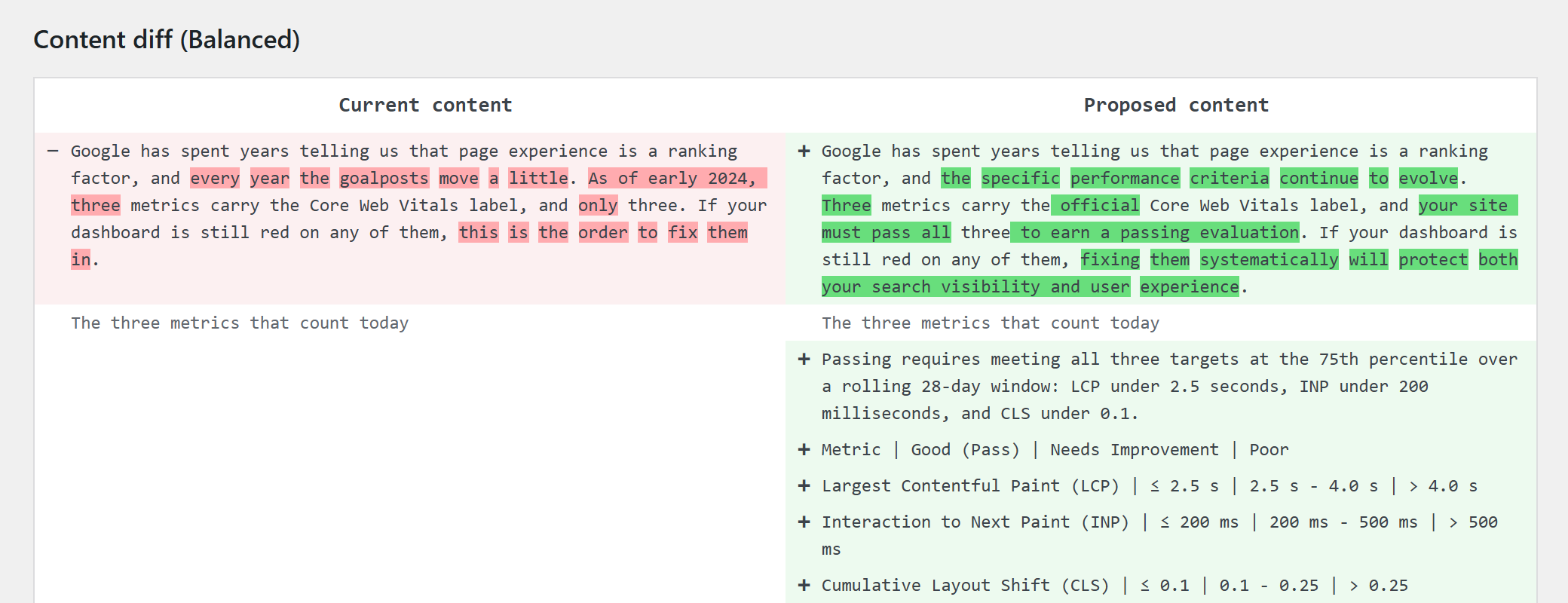
In Unstale's review queue, the diff compares the post as plain text, tags stripped, line by line. A reworded section heading, a rewritten paragraph or prose turned into a table shows up. A heading level changed with the same words, bold text, an embed removed at publication, an uncaptioned image added or removed, or a link whose target alone changed does not. The proposed post title, meta title and meta description sit above the diff as values only, without the old ones, and structured data gets a single line.
The screenshot below is one such diff at Balanced: an unchanged heading line, a reworded paragraph that drops "As of early 2024", and an added comparison table.
Scaled content abuse: what the 2024 policy says about volume
Scaled content abuse is Google's name for many pages produced mainly to manipulate rankings with little value for readers, and since March 2024 it applies whether a model or a person does the producing. Google's spam policies, last updated 2026-08-28, define it this way:
"Scaled content abuse is when many pages are generated for the primary purpose of manipulating search rankings and not helping users."
Google's first example is "Using generative AI tools or other similar tools to generate many pages without adding value for users". Across its spam policies, Google warns: "Sites that violate our policies may rank lower in results or not appear in results at all."
In our reading, the policy weighs purpose and added value, not the tool, and rewriting existing posts in place is not generating new pages. Rewriting many posts at once with nobody reading them removes the moment when someone judges whether each still adds value. Google's people-first guide also asks: "Are you adding a lot of new content or removing a lot of older content primarily because you believe it will help your search rankings overall by somehow making your site seem "fresh?" (No, it won't)"
Four of the ways a refresh starts in Unstale, and how far each reaches:
| How a refresh starts | The widest it goes | Who can start it |
|---|---|---|
| From the post editor, or a post's own link in the posts list | One post | Editors and Administrators |
| Get started screen, free plugin | 5 posts | Editors and Administrators |
| Content health screen, free plugin | Up to 50 posts at once | Editors and Administrators |
| Scheduled automation, Unstale Pro | Off by default; when on, 5 posts per daily pass by default, 50 per pass at most, and a pass can be set to run hourly | Administrators turn it on |
By default, a refresh waits in the review queue until someone approves it. Automatic publishing, off by default, skips that wait, and the Pro automation screen warns in bold: "Refreshed content goes live with nobody reading it first." These limits apply per action or per pass, not per day. No Unstale setting caps how many batches you start, and Unstale does not judge whether a batch adds value. In our reading, the pace to rely on is the pace at which someone reads the diffs.
The URL, the outline and the way back, for a page that already ranks
A refresh in Unstale publishes to the same address, asks the model to keep the outline at three of four levels, and waits in the review queue, diff attached, until someone approves it, unless automatic publishing is on.
The same URL
Publishing writes the post content, never the slug. The publish date moves by default, but not when your permalinks contain the core date tags, so a dated address stays put. Presenting an old post as new raises questions of its own: republishing and rankings.
The outline, level by level
Minimal and Balanced are told to keep your heading structure, Strong to keep headings and sections in order, with room to reword a heading. Maximal alone is told to rebuild the outline while still delivering what the title promises. Code refuses some outputs, such as a rewrite under 30% of the original word count, but no code check guards section headings or the outline. The net there is the review queue, while automatic publishing stays off. What each level may change is compared in the guide to rewrite old posts with AI.
The way back
If the post content changed after the refresh started, publishing refuses. Before writing, Unstale saves a way back: in the WordPress editor, block or classic, and on Divi, a revision in WordPress's revision history, so no Restore there with revisions turned off; on Elementor and SeedProd, its own snapshot, outside the revisions. Restore is a link in the Unstale block under the editor, visible while that refresh is the post's latest, and it opens a confirmation screen. It has no time limit, but it refuses once the post content has been edited, pointing you to the revisions; a title or meta edit alone does not block it. The screens are in the docs.
What nobody can promise, including us
No tool, study or Google statement tells you how a given page will move after a rewrite, and neither this page nor Unstale does.
- No ranking outcome. The sources above describe a correlation and policies, not the future of one page.
- No lock on headings. Headings and outline rest on instructions to the model, not on code.
- No complete diff. A heading level, bold text, an embed removed at publication, an added or removed image, or a link target can change without showing in it.
- No full check of new claims. A new claim without a new figure, anything past 12 passages or 400 words, the post title, the meta fields and the structured data are not checked after the rewrite.
- No review once automatic publishing is on. Refreshed posts then go live without it.
- No fixed publish date. It moves by default unless your permalinks use the core date tags or you untick "Update the publish date when a refreshed post goes live".
A measurement is running on the author's own site, with no result published yet. Which posts deserve a refresh at all comes first: refresh old WordPress posts.
Questions about AI rewriting and Google rankings
Does Google penalize AI-generated content?
Not for being AI-generated. Google's 2023 guidance says "Appropriate use of AI or automation is not against our guidelines." Generating content mainly to manipulate rankings is against its spam policies, and since 2024 so is producing content at scale for that purpose, whether people or automation are behind it.
Will rewriting AI content by hand save a low-quality site?
Not by itself, going by Google's John Mueller. Asked about a small, low-quality, mostly AI-written site that was not indexed, he pointed to the value the site adds and said "Just rewriting AI content by a human won't change that". His was a forum reply reported by Search Engine Roundtable, not an official Google channel.
Can Google tell that a post was rewritten by AI?
None of the Google documents cited here describes an AI detector used in ranking. Google's 2023 guidance says its systems, including SpamBrain, "analyze patterns and signals to help us identify spam content, however it is produced." Third-party detectors are another matter: Ahrefs says AI detectors "deal in probabilities, not certainty."
Should a refreshed post say that AI helped?
Google's people-first content guide says "AI or automation disclosures are useful for content where someone might think "How was this created?"" and suggests adding them "when it would be reasonably expected." Unstale adds no such mention to the posts it refreshes, so whether to add one is the site's call.
Does Unstale publish a rewrite before anyone approves it?
Not by default. A refresh waits in the review queue, with its diff, until an Editor or Administrator approves or rejects it. Automatic publishing is off by default. An Administrator can turn it on, and from then on refreshed posts go live without that review.
Run one refresh, then read what changed
Pick a post that still ranks, run it at Minimal, and read its diff with Google's questions above in mind before you approve anything. What the review queue shows is in the docs.
Quoted material from Google Search Central is used under the Creative Commons Attribution 4.0 License. Sources: "Google Search's guidance about AI-generated content", Google Search Central Blog, 2023-02-08; "What web creators should know about our March 2024 core update and new spam policies", Google Search Central Blog, 2024-03-05; "Spam policies for Google web search", "Creating helpful, reliable, people-first content" and "Google Search's guidance on using generative AI content on your website", Google Search Central documentation.